

Not All Grounding Software Uses the Same Physics.
Compare seven leading grounding software packages. Understand the difference between conventional grounding calculations and full-wave electromagnetic simulation.
Full-wave Grounding Tools
Documented full-wave electromagnetic solvers
XGSLab · CDEGS
Engineering Grounding Tools
Grounding-focused models and workflows
ELEK · ETAP · SKM · Eaton · APC
The purpose of this guide is to compare seven leading grounding software packages, to help readers understand the difference between conventional grounding calculations and full-wave electromagnetic simulation, and to assist those looking to choose a grounding software program.
Explore the comparison
Grounding software packages differ in their underlying physical models, simulation capabilities and intended applications.
The following comparison highlights these differences based on publicly available manufacturers' documentation, without subjective scores or rankings.
| Software | Category | Full-Wave Capability | Main Strengths |
|---|---|---|---|
| SINT XGSLab | Full-wave | DocumentedFull-wave PEEC (GSA_FD, XGSA_FD; XGSA_TD via XGSA_FD) | Advanced grounding, electromagnetic fields, interference, complex soil modeling including multiregion, frequency-domain and transient analysis. |
| SES CDEGS | Full-wave | DocumentedFull-wave integral equations (HIFREQ) | Advanced grounding, electromagnetic fields, interference, complex soil modeling including finite volumes, frequency-domain and transient analysis. |
| ELEK SafeGrid | Engineering | Not establishedfrom reviewed public documentation | Multilayer soil, non-equipotential grounding, safety assessment, high-frequency and transient capabilities. |
| ETAP Ground Grid | Engineering | Not publicly documented | FEM grounding calculations, two-layer soil modeling, integration with power-system studies. |
| SKM GroundMat | Engineering | Not publicly documented | FEM grounding analysis, grid optimization and safety assessment. |
| Eaton CYMGRD | Engineering | Not publicly documented | FEM grounding analysis, uniform and two-layer soil, touch and step voltage assessment. |
| APC WinIGS | Engineering | Not establishedfrom reviewed public documentation | Integrated grounding and power-system modeling, fault-current analysis, inductive and capacitive effects. |
Understanding the classification
Software suites offering a publicly documented full-wave electromagnetic solver, capable of representing electromagnetic propagation effects.
Software primarily focused on grounding design and electrical safety, for which comparable full-wave capabilities have not been established from the public documentation reviewed.
Important: “Not publicly documented” or “Not established” does not mean “Not supported.” The classification concerns documented modeling capabilities, not accuracy, quality or suitability for conventional grounding applications.
Sources: Official manufacturers' documentation. Reviewed October 2026. Capabilities may depend on software versions and licensed modules.
Technical guidePhysics first, features second
The main difference between software platforms is not simply the number of features, but the physical phenomena their calculation models can represent.
1. Full-wave capability: what it means
A full-wave electromagnetic model retains wave-propagation and phase effects when solving Maxwell’s equations. Non-equipotential conductors, FEM, frequency-dependent impedances and transient calculations do not, by themselves, demonstrate full-wave capability. For compact systems at power frequency, appropriate quasi-static methods may be equally accurate and faster.
XGSLab GSA_FD/XGSA_FD and CDEGS HIFREQ have documented full-wave solvers. XGSA_TD extends XGSA_FD results to the time domain through a frequency-domain approach. For the other products listed, comparable full-wave capability has not been established from the reviewed public documentation.
2. Software strengths and considerations
The overview table identifies the modeling category. The following concise notes highlight practical differences; they are not rankings.
| Software | Strengths | Technical Considerations |
|---|---|---|
| XGSLab | Full-wave PEEC; advanced soil models including Multi-Region; electromagnetic interference and CAD-oriented workflow. | Advanced studies require expertise. Multi-Region models lateral soil variability using geostatistical interpolation of field measurements, providing a practical, data-driven alternative to arbitrary 3D soil maps. |
| SES CDEGS | Full-wave MOM; broad electromagnetic applications and advanced soil-modeling options. | Capabilities are distributed among specialized modules and may require significant training. |
| ELEK SafeGrid | Grounding-oriented workflow; multilayer soil, non-equipotential analysis, high-frequency and transient features. | A full-wave formulation has not been established from the public technical material reviewed. |
| ETAP Ground Grid | FEM grounding and safety analysis integrated with power-system studies. | Primarily focused on grounding; full-wave grounding capability is not publicly documented. |
| SKM GroundMat | FEM grounding calculations, potential distribution and safety assessment. | Primarily dedicated to grounding; full-wave capability is not publicly documented. |
| Eaton CYMGRD | Grounding-grid design, FEM calculations and touch/step voltage assessment. | Focused on grounding; full-wave capability is not publicly documented. |
| APC WinIGS | Grounding and power-network integration, including conductor impedance effects. | A full-wave formulation has not been established from the public material reviewed. |
3. Similar results do not mean equivalent models
ELEK published a comparison of SafeGrid, XGSLab and CDEGS for a 60 × 60 m grounding grid in multilayer soils, reporting ground-resistance differences below 1%. This is useful agreement for the tested cases, but it does not establish equivalence of the underlying models. Static, quasi-static and full-wave approaches may agree closely when propagation effects are negligible; broader validation should also examine current distribution, voltages and electromagnetic fields.
Reference: ELEK published comparison
4. Five questions before selecting software
- Is full-wave analysis available when needed?
- Which soil models are supported?
- Which coupling phenomena are included?
- How has the calculation model been validated?
- Does the workflow meet the project and organizational requirements?
5. Why consider XGSLab?
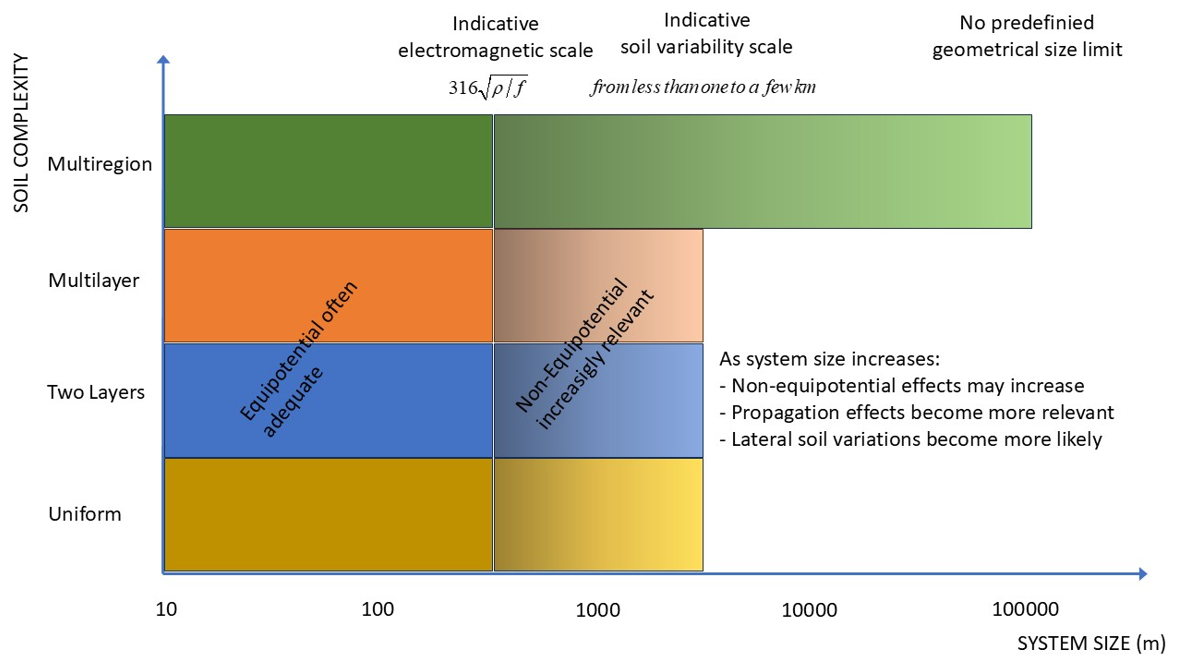
XGSLab combines documented full-wave PEEC capabilities with practical grounding tools, CAD-oriented modeling and advanced soil representations, including Multi-Region. XGSLab offers modeling capabilities suitable for a wide range of system sizes and soil conditions, as illustrated below. It supports projects ranging from conventional grounding studies to complex electromagnetic interference and transient analyses.
Evaluate XGSLab with a representative engineering project.
Technical sources and transparency
Prepared with AI assistance using publicly available manufacturer information and reviewed by SINT, the developer of XGSLab. This is a manufacturer-authored comparison, not independent testing or a ranking. A capability not established in public documentation must not be interpreted as absent.
Manufacturer sources: XGSLab · CDEGS · SafeGrid · ETAP · SKM · Eaton CYMGRD · WinIGS
This comparison is based on publicly available technical documentation. Manufacturers are welcome to provide additional information or corrections, which will be reviewed and incorporated where appropriate.
Information reviewed: October 2026. All trademarks belong to their respective owners.